Lecture: Section 15.6 Triple Integrals
Welcome! We have seen how single integrals $\int_a^b f(x) \,dx$ allow us to find the area under a 2D curve, and double integrals $\iint_D f(x,y) \,dA$ allow us to find the volume under a 3D surface.
Today, we move into the third dimension with Triple Integrals. It is tempting to think this will compute "hypervolume" in 4D, and mathematically it does. But for us, it has a much more physical and intuitive meaning.
Why do we need Triple Integrals? (Analogy 1: 3D Printing)
Think about manufacturing a part with a 3D printer. If you want the mechanical part to be heavier and stronger at the base but lighter at the top, you change the infill density at different locations. The function $f(x,y,z)$ represents that changing density at any specific coordinate point $(x,y,z)$.
The triple integral simply adds up all the microscopic bits of varying mass inside the object to find the total mass of the printed part.
Why do we need Triple Integrals? (Analogy 2: The Heated Room)
Not into manufacturing? Imagine a large auditorium in the middle of winter. There is a massive industrial heater blasting in one corner, and an open window letting in freezing air in the opposite corner.
The temperature is not constant; it changes depending on exactly where you sit or stand. The function $f(x,y,z)$ represents the specific temperature at any coordinate in the air. If you want to calculate the average temperature of the entire auditorium, you must sum up the temperature at every microscopic point in the air using a triple integral.
Crucial Intuition: The function $f(x,y,z)$ tells you what is happening inside the space (the density or the temperature). But the limits of integration come entirely from the physical geometric shape of the solid domain itself (the "g-code" shape of the plastic part, or the walls, floor, and ceiling of the room).
What is a Triple Integral?
A triple integral $\iiint_E f(x,y,z) \,dV$ is the integral of a function $f(x,y,z)$ over a 3D solid region $E$.
We find it by chopping the region $E$ into tiny boxes, each with volume $\Delta V = \Delta x \Delta y \Delta z$. We take the value of $f$ at a point in each box, multiply it by $\Delta V$, and add them all up:
$$ \iiint_E f(x,y,z) \,dV = \lim_{\Delta V \to 0} \sum f(x_i, y_j, z_k) \Delta V $$
The two most important interpretations:
- If $f(x,y,z) = 1$, then the integral is the Volume of the solid $E$.
$$ V(E) = \iiint_E 1 \,dV $$ - If $f(x,y,z) = \rho(x,y,z)$ (a density function), then the integral is the Mass of the solid $E$.
$$ m(E) = \iiint_E \rho(x,y,z) \,dV $$
Part 1: Triple Integrals over Rectangular Boxes 📦
Just like with double integrals, we start with the simplest possible region: a rectangular box.
A box $B$ can be defined as $B = [a, b] \times [c, d] \times [r, s]$, which means $a \le x \le b$, $c \le y \le d$, and $r \le z \le s$.
Fubini's Theorem (for Triple Integrals)
If $f$ is continuous on the rectangular box $B$, then we can compute the triple integral as an iterated integral. The order of integration does not matter.
$$ \iiint_B f(x,y,z) \,dV = \int_r^s \int_c^d \int_a^b f(x,y,z) \,dx \,dy \,dz $$
We can use any of the $3! = 6$ possible orders of integration ($dx\,dy\,dz$, $dz\,dx\,dy$, etc.).
Example 1: Evaluating over a Box
The temperature at any point in a room $(x,y,z)$ is measured and found to be $T(x,y,z) = xyz^2$. The room is placed on the 3D coordinate system and the length, width, and height fit in the intervals $B = [1, 2] \times [-1, 1] \times [0, 3]$. Evaluate the triple integral $\iiint_B T(x,y,z) \,dV$ over this room $B$.
Stop and Draw!
Before writing a single integral sign, you must sketch the 3D domain. Draw your $x$, $y$, and $z$ axes. Mark $x$ from 1 to 2, $y$ from -1 to 1, and $z$ from 0 to 3. Connect the lines to form a rectangular prism. Do not skip this step. Building the habit of drawing the domain now will save you when the shapes turn into complex curves in the next section.
Compare your drawing to the mathematical reality below. Notice how the limits define the rigid walls of the box.
The solid box $B$ suspended in 3D space, bounded by the constants of integration.
Solution:
Let's choose the order $dx\,dy\,dz$.
$$ \underbrace{\int_0^3 \int_{-1}^1 \int_1^2}_{\text{this is the volume}} \underbrace{xyz^2}_{\text{This is the function evaluated over the volume}} \,dx \,dy \,dz $$
Crucial Connection: The limits over the first underbrace perfectly map the physical domain (the dimensions of the room). The function $T(x,y,z) = xyz^2$ over the second underbrace simply evaluates the temperature at any specific coordinate point inside that room.
Inner (with respect to $x$):
$$ \int_1^2 xyz^2 \,dx = yz^2 \left[ \frac{1}{2}x^2 \right]_1^2 = yz^2 \left( \frac{4}{2} - \frac{1}{2} \right) = \frac{3}{2} yz^2 $$
Middle (with respect to $y$):
$$ \int_{-1}^1 \frac{3}{2} yz^2 \,dy = \frac{3}{2}z^2 \left[ \frac{1}{2}y^2 \right]_{-1}^1 = \frac{3}{2}z^2 \left( \frac{1}{2} - \frac{1}{2} \right) = 0 $$
Outer (with respect to $z$):
$$ \int_0^3 0 \,dz = 0 $$
(Note: The integral is zero because the function $T(x,y,z) = xyz^2$ is an odd function with respect to $y$, and we integrated over a symmetric $y$-interval $[-1, 1]$.)
Example 2: Separable Integrals
Evaluate $\iiint_B e^{x+y+z} \,dV$ over the box $B = [0, 1] \times [0, \ln(2)] \times [0, \ln(3)]$.
Draw it!
Sketch this one too. Because one corner is anchored at the origin $(0,0,0)$ and all boundaries are positive, this box sits perfectly tucked into the corner of the first octant.
Solution:
The function can be written as $f(x,y,z) = e^x e^y e^z$. When the function is separable and the limits are constants, we can separate the integral:
$$ \iiint_B e^x e^y e^z \,dV = \left( \int_0^1 e^x \,dx \right) \left( \int_0^{\ln(2)} e^y \,dy \right) \left( \int_0^{\ln(3)} e^z \,dz \right) $$
$$ = \left[ e^x \right]_0^1 \cdot \left[ e^y \right]_0^{\ln(2)} \cdot \left[ e^z \right]_0^{\ln(3)} $$
$$ = (e^1 - e^0) \cdot (e^{\ln(2)} - e^0) \cdot (e^{\ln(3)} - e^0) $$
$$ = (e - 1) \cdot (2 - 1) \cdot (3 - 1) = 2(e - 1) $$
Check Your Understanding #1
Evaluate $\int_0^{\pi} \int_0^1 \int_0^2 z \cos(y) \,dx \,dz \,dy$.
Part 2: Triple Integrals over General Regions 🏔️
This is where things get interesting. Most solids are not simple boxes. We must define our limits of integration using functions that perfectly map the solid's geometry.
The Strategy: The Flashlight and the Laser
To set up the limits for a solid $E$, we visually break the problem into two distinct physical parts:
- The Laser (Inner Integral): Imagine standing below the solid and firing a laser straight up, parallel to the $z$-axis. The laser enters the solid at a bottom surface (the Floor) and exits the solid at a top surface (the Ceiling). This gives you your $z$-bounds: $\int_{\text{Floor}}^{\text{Ceiling}} dz$.
- The Flashlight (Outer Integrals): Now, hover high above the solid on the $z$-axis and shine a massive flashlight straight down. The solid will cast a 2D shadow onto the $xy$-plane below. That shadow is your 2D domain $D$. The outer double integral $\iint_D dA$ is simply the 2D area of that shadow, solved exactly like Section 15.2.
The 2-1-0 Rule (Dimensionality Countdown)
When setting up the bounds of a triple integral $\iiint_E f \,dz \,dy \,dx$, you must lose a dimension at every step. If you do not, your final answer will be a variable instead of a number!
- Inner Limits (Surface): Can contain 2 variables (e.g., $z = 2 - x - 2y$). We are bounding a 3D volume between 2D surfaces.
- Middle Limits (Curve): Can contain 1 variable maximum (e.g., $y = 1 - x/2$). We have "smashed" the volume flat into a 2D shadow, and are now bounding it between 1D curves.
- Outer Limits (Points): Must strictly be 0 variables (constants, e.g., $x=0$ to $x=2$). We have smashed the shadow onto a single axis, bounded by 0D points.
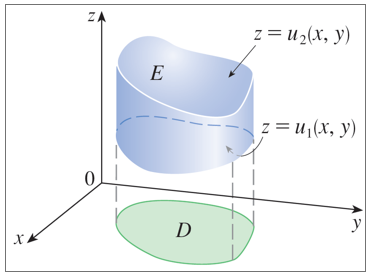
A general $z$-simple region $E$ bounded by a floor $z=u_1(x,y)$ and a ceiling $z=u_2(x,y)$. Its shadow $D$ lies in the $xy$-plane.
Example 3: Volume of a Tetrahedron
Find the volume of the solid tetrahedron $E$ bounded by the planes $x + 2y + z = 2$, $x = 0$, $y = 0$, and $z = 0$.
Solution:
Step 1: Use the Laser to find the $z$-limits (floor and ceiling).
The solid tetrahedron $E$ in the first octant.
A laser beam parallel to the $z$-axis enters at the "floor" $z = 0$. It exits at the "ceiling", which is the slanted plane $x + 2y + z = 2$. We solve this for $z$:
$$ z = 2 - x - 2y $$
So, our inner $z$-limits are $0 \le z \le 2 - x - 2y$. (Notice: 2 variables! The 2-1-0 rule is working).
Step 2: Use the Flashlight to find the 2D shadow region $D$.
The shadow $D$ is the footprint the solid leaves on the $xy$-plane. We find this "equator" by finding where the ceiling crashes into the floor. We set $z=0$ in the ceiling equation: $0 = 2 - x - 2y$, which gives $x + 2y = 2$.
This line, along with $x=0$ and $y=0$, forms our triangular shadow $D$. We can write $D$ as a Type I 2D region:
Solve for $y$: $y = 1 - x/2$. So, $D = \{ (x,y) \mid 0 \le x \le 2, \, 0 \le y \le 1 - x/2 \}$.
The triangular shadow $D$ in the $xy$-plane, bounded by $x=0$, $y=0$, and $x+2y=2$.
Step 3: Set up and evaluate the full integral.
Check the 2-1-0 rule: Inner bounds have $x,y$. Middle bounds have $x$. Outer bounds are constants. Perfect.
$$ V = \int_0^2 \int_0^{1-x/2} \left( \int_0^{2-x-2y} 1 \,dz \right) \,dy \,dx $$
Inner ($dz$): $\int_0^{2-x-2y} 1 \,dz = [z]_0^{2-x-2y} = 2 - x - 2y$.
Middle ($dy$): $\int_0^{1-x/2} (2 - x - 2y) \,dy = [2y - xy - y^2]_0^{1-x/2}$
$$ = \left( 2(1-\frac{x}{2}) - x(1-\frac{x}{2}) - (1-\frac{x}{2})^2 \right) - 0 $$
$$ = (2 - x) - (x - \frac{x^2}{2}) - (1 - x + \frac{x^2}{4}) $$
$$ = 2 - x - x + \frac{x^2}{2} - 1 + x - \frac{x^2}{4} = 1 - x + \frac{x^2}{4} $$
Outer ($dx$): $\int_0^2 (1 - x + \frac{x^2}{4}) \,dx = [x - \frac{x^2}{2} + \frac{x^3}{12}]_0^2$
$$ = (2 - \frac{4}{2} + \frac{8}{12}) - 0 = (2 - 2 + \frac{2}{3}) = \frac{2}{3} $$
Example 4: Volume Between Two Surfaces
Find the volume of the solid $E$ bounded between the two paraboloids $z_1 = x^2+y^2$ (the "floor") and $z_2 = 8 - x^2 - y^2$ (the "ceiling").
Solution:
Step 1 (Laser / $z$-limits): The problem gives them to us. The floor is $z_1 = x^2+y^2$. The ceiling is $z_2 = 8 - x^2 - y^2$.
Step 2 (Flashlight / Shadow $D$): To find the $xy$-shadow, we find where the floor and ceiling intersect by setting them equal (smashing them flat):
$$ x^2+y^2 = 8 - x^2 - y^2 \implies 2x^2 + 2y^2 = 8 \implies x^2+y^2 = 4 $$
The shadow is a circle in the $xy$-plane of radius 2, centered at the origin.
click off f(x,y) and g(x,y) to see the volume to be computed and see the domain D in the xy plane
Step 3 (Integral): We set up the $...dz \,dy \,dx$ integral. We describe the circular shadow $D$ as a 2D region:
- $-2 \le x \le 2$
- $-\sqrt{4-x^2} \le y \le \sqrt{4-x^2}$
Inner ($dz$): $\int_{x^2+y^2}^{8-x^2-y^2} 1 \,dz = [z]_{x^2+y^2}^{8-x^2-y^2} = (8 - x^2 - y^2) - (x^2+y^2) = 8 - 2x^2 - 2y^2$.
Outer Double Integral:
$$ V = \int_{-2}^2 \int_{-\sqrt{4-x^2}}^{\sqrt{4-x^2}} (8 - 2(x^2+y^2)) \,dy \,dx $$
Converting to Polar Coordinates
This integral is very difficult in rectangular coordinates. We can solve it by converting the double integral to polar coordinates.
- The Region $D$: The shadow is a circle $x^2+y^2 \le 4$. In polar, this is simply $0 \le r \le 2$ and $0 \le \theta \le 2\pi$.
- The Integrand: $8 - 2(x^2+y^2)$ becomes $8 - 2r^2$.
- The Differential: $dy \,dx$ becomes $r \,dr \,d\theta$.
Set up the Polar Integral:
$$ V = \int_0^{2\pi} \int_0^2 (8 - 2r^2) \cdot r \,dr \,d\theta $$
$$ V = \int_0^{2\pi} \int_0^2 (8r - 2r^3) \,dr \,d\theta $$
Inner ($dr$): $\int_0^2 (8r - 2r^3) \,dr = \left[ 4r^2 - \frac{2r^4}{4} \right]_0^2 = \left[ 4r^2 - \frac{r^4}{2} \right]_0^2$
$$ = \left( 4(2)^2 - \frac{(2)^4}{2} \right) - 0 = \left( 16 - \frac{16}{2} \right) = 16 - 8 = 8 $$
Outer ($d\theta$):
$$ V = \int_0^{2\pi} 8 \,d\theta = [8\theta]_0^{2\pi} = 8(2\pi) - 0 = 16\pi $$
Check Your Understanding #2
Set up (but do not evaluate) a triple integral for the mass of the solid $E$ bounded by the parabolic cylinder $z = 1 - y^2$ and the planes $z=0$, $x=0$, $x=1$. The density is given by $\rho(x,y,z) = xz$.
Part 3: A Visual Strategy for Changing Integration Order 🔃
Visualizing the 3D solid is the hardest part of changing the integration order. Instead of a purely algebraic method, let's use a visual, graph-based approach. We will tackle one problem in two different orders to see how the perspective changes.
Example 5: A New Solid - Order 1 ($dz \,dy \,dx$)
Find the volume of the solid $E$ bounded by the surfaces $z=y+1$, $z=x^2+1$, and $y=1$.
Solution (a): Order $dz \,dy \,dx$
Let's start by visualizing the solid. The boundaries are two "troughs" ($z=y+1$ and $z=x^2+1$) cut by the vertical plane $y=1$.
The solid $E$ bounded by $z=y+1$ (red), $z=x^2+1$ (blue), and $y=1$ (green).
We want to set up $V = \iiint_E 1 \,dz \,dy \,dx$. This means our shadow $D$ is in the $xy$-plane. Let's use this view to find the bounds:
Visualizing the order dzdydx, we will go from the bottom surface z = x^2+1 to the top surface z = y+1. the middle integral is y = x^2 to y = 1 and the outer integral is -1 to 1
1. Inner ($z$) bounds: The Laser enters the solid at the "floor" $z = x^2+1$ and exits at the "ceiling" $z=y+1$. So, $x^2+1 \le z \le y+1$.
2. Shadow ($D_{xy}$) bounds: The shadow cast by the Flashlight is bounded by the plane $y=1$ and the intersection of the two surfaces: $y+1 = x^2+1 \implies y = x^2$. So the shadow is bounded by the line $y=1$ and the parabola $y=x^2$.
For $...dy \,dx$, we have outer $x$-bounds from $-1$ to $1$, and inner $y$-bounds from $y=x^2$ to $y=1$.
3. Set up and Integrate:
$$ V = \int_{-1}^1 \int_{x^2}^1 \int_{x^2+1}^{y+1} 1 \,dz \,dy \,dx $$
Inner ($dz$): $\int_{x^2+1}^{y+1} 1 \,dz = [z]_{x^2+1}^{y+1} = (y+1) - (x^2+1) = y - x^2$.
Middle ($dy$): $\int_{x^2}^1 (y - x^2) \,dy = \left[ \frac{1}{2}y^2 - x^2y \right]_{x^2}^1$
$$ = \left( \frac{1}{2}(1)^2 - x^2(1) \right) - \left( \frac{1}{2}(x^2)^2 - x^2(x^2) \right) = \left(\frac{1}{2} - x^2\right) - \left(\frac{1}{2}x^4 - x^4\right) = \frac{1}{2} - x^2 + \frac{1}{2}x^4 $$
Outer ($dx$): $\int_{-1}^1 \left(\frac{1}{2} - x^2 + \frac{1}{2}x^4\right) \,dx$. This is an even function, so we can simplify:
$$ = 2 \int_0^1 \left(\frac{1}{2} - x^2 + \frac{1}{2}x^4\right) \,dx = 2 \left[ \frac{1}{2}x - \frac{1}{3}x^3 + \frac{1}{10}x^5 \right]_0^1 $$
$$ = 2 \left( \left(\frac{1}{2} - \frac{1}{3} + \frac{1}{10}\right) - 0 \right) = 2 \left( \frac{15 - 10 + 3}{30} \right) = 2 \left( \frac{8}{30} \right) = \frac{16}{30} = \frac{8}{15} $$
Solution (b): Same Solid, New Order ($dx \,dz \,dy$)
Now, what if we want to change the order to $dx \,dz \,dy$? This means our Flashlight is now shining along the $x$-axis, casting a shadow $D$ onto the $yz$-plane.
1. Inner ($x$) bounds: First, solve any surface involving $x$ for $x$. We have $z = x^2+1 \implies x^2 = z-1 \implies x = \pm\sqrt{z-1}$. This also tells us we must have $z \ge 1$.
Our "Laser" (now parallel to the $x$-axis) enters at the "floor" $x = -\sqrt{z-1}$ and exits at the "ceiling" $x = \sqrt{z-1}$. So, $-\sqrt{z-1} \le x \le \sqrt{z-1}$.
2. Shadow ($D_{yz}$) bounds: Now we find the shadow in the $yz$-plane. We are bounded by $y=1$ (a line) and $z=y+1$ (a line). What about $z=x^2+1$? Since $x$ is "crushed" onto this plane, its smallest value is $x=0$. This occurs on the $yz$-plane itself. The surface $z=x^2+1$ starts at $z=1$ (when $x=0$).
So, our shadow is bounded by the three lines: $y=1$, $z=y+1$, and $z=1$.
The $yz$-shadow (in purple) is bounded by $y=1$, $z=y+1$, and $z=1$.
For $...dz \,dy$, our outer $y$-bounds are $0 \le y \le 1$. Our inner $z$-bounds are from the floor $z=1$ up to the ceiling $z=y+1$.
3. Set up and Integrate:
$$ V = \int_0^1 \int_1^{y+1} \int_{-\sqrt{z-1}}^{\sqrt{z-1}} 1 \,dx \,dz \,dy $$
Inner ($dx$): $\int_{-\sqrt{z-1}}^{\sqrt{z-1}} 1 \,dx = [x]_{-\sqrt{z-1}}^{\sqrt{z-1}} = \sqrt{z-1} - (-\sqrt{z-1}) = 2\sqrt{z-1}$.
Middle ($dz$): $\int_1^{y+1} 2(z-1)^{1/2} \,dz = 2 \left[ \frac{2}{3}(z-1)^{3/2} \right]_1^{y+1}$
$$ = \frac{4}{3} \left[ ((y+1)-1)^{3/2} - (1-1)^{3/2} \right] = \frac{4}{3} [y^{3/2} - 0] = \frac{4}{3}y^{3/2} $$
Outer ($dy$): $\int_0^1 \frac{4}{3}y^{3/2} \,dy = \frac{4}{3} \left[ \frac{2}{5}y^{5/2} \right]_0^1 = \frac{8}{15}(1 - 0) = \frac{8}{15}$.
Both methods give the same volume, $V = 8/15$, which confirms our bounds are correct!
Example 6: Evaluating an "Impossible" Integral
Evaluate $\int_0^2 \int_0^{4-x^2} \int_0^x \frac{\sin(2z)}{4-z} \,dy \,dz \,dx$.
Solution:
Let's try to integrate as written.
Inner ($dy$): $\int_0^x \frac{\sin(2z)}{4-z} \,dy = x \frac{\sin(2z)}{4-z}$.
Middle ($dz$): $\int_0^{4-x^2} x \frac{\sin(2z)}{4-z} \,dz$. This requires us to find the antiderivative of $\frac{\sin(2z)}{4-z}$, which is not possible with standard functions . We must change the order.
Our goal is to make $dz$ the *outer* integral, hoping the inner two integrals simplify the $z$-term.
The original bounds are: $0 \le x \le 2$, $0 \le z \le 4-x^2$, and $0 \le y \le x$. Let's visualize this solid.
Visualize the surface bounded by all constraints.
We want the new order $dy\,dx\,dz$. This means our shadow is on the $xz$-plane. Let's look at that shadow $D_{xz}$ and its new $dx\,dz$ order.
The shadow $D_{xz}$ (purple) is bounded by $x=0, z=0$, and $z=4-x^2$.
To change to a $dx \,dz$ order, we solve for $x$: $z=4-x^2 \implies x^2=4-z \implies x = \sqrt{4-z}$ (since $x \ge 0$).
Our new outer $z$-bounds are $0 \le z \le 4$. Our new middle $x$-bounds are $0 \le x \le \sqrt{4-z}$.
The inner $y$-bounds are given by $y=x$ (ceiling) and $y=0$ (floor), so $0 \le y \le x$.
Set up and Integrate:
$$ \int_0^4 \int_0^{\sqrt{4-z}} \int_0^x \frac{\sin(2z)}{4-z} \,dy \,dx \,dz $$
Inner ($dy$): $\int_0^x \frac{\sin(2z)}{4-z} \,dy = x \frac{\sin(2z)}{4-z}$.
Middle ($dx$): $\int_0^{\sqrt{4-z}} x \frac{\sin(2z)}{4-z} \,dx = \frac{\sin(2z)}{4-z} \left[ \frac{1}{2}x^2 \right]_0^{\sqrt{4-z}}$
$$ = \frac{\sin(2z)}{4-z} \left( \frac{(\sqrt{4-z})^2}{2} - 0 \right) = \frac{\sin(2z)}{4-z} \left( \frac{4-z}{2} \right) = \frac{1}{2}\sin(2z) $$
Outer ($dz$): $\int_0^4 \frac{1}{2}\sin(2z) \,dz = \left[ -\frac{1}{4}\cos(2z) \right]_0^4 $
$$ = \left(-\frac{1}{4}\cos(8)\right) - \left(-\frac{1}{4}\cos(0)\right) = \frac{1 - \cos(8)}{4} $$
Check Your Understanding #3
Set up the integral $\iiint_E y \,dV$ where $E$ is bounded by $y=0, y=2, x=0, z=0$, and $z=9-x^2$ in two orders: $dz\,dy\,dx$ and $dx\,dy\,dz$.
Part 4: Applications of Triple Integrals 📐
We can use triple integrals to find properties of 3D solids, not just mass and volume.
Formulas for Applications
Let $E$ be a solid region with a continuous density function $\rho(x,y,z)$.
- Volume: $V = \iiint_E 1 \,dV$
- Mass: $m = \iiint_E \rho(x,y,z) \,dV$
- Moments about Coordinate Planes:
- $M_{yz} = \iiint_E x \rho(x,y,z) \,dV$ (Moment about $yz$-plane)
- $M_{xz} = \iiint_E y \rho(x,y,z) \,dV$ (Moment about $xz$-plane)
- $M_{xy} = \iiint_E z \rho(x,y,z) \,dV$ (Moment about $xy$-plane)
- Center of Mass $(\bar{x}, \bar{y}, \bar{z})$: $$ \bar{x} = \frac{M_{yz}}{m}, \quad \bar{y} = \frac{M_{xz}}{m}, \quad \bar{z} = \frac{M_{xy}}{m} $$ (If density is constant, this is called the Centroid.)
- Average Value of a Function $f$: $$ f_{\text{avg}} = \frac{1}{V(E)} \iiint_E f(x,y,z) \,dV $$
Example 7: Average Value
Find the average value of $f(x,y,z) = xyz$ over the box $B = [0, 1] \times [0, 2] \times [0, 3]$.
Solution:
Step 1: Find the Volume $V(B)$.
$V = (1-0) \cdot (2-0) \cdot (3-0) = 6$.
Step 2: Find the integral $\iiint_B f \,dV$.
$$ \iiint_B xyz \,dV = \left( \int_0^1 x \,dx \right) \left( \int_0^2 y \,dy \right) \left( \int_0^3 z \,dz \right) $$
$$ = \left[ \frac{x^2}{2} \right]_0^1 \cdot \left[ \frac{y^2}{2} \right]_0^2 \cdot \left[ \frac{z^2}{2} \right]_0^3 $$
$$ = \left( \frac{1}{2} \right) \cdot \left( \frac{4}{2} \right) \cdot \left( \frac{9}{2} \right) = \frac{1}{2} \cdot 2 \cdot \frac{9}{2} = \frac{9}{2} $$
Step 3: Calculate the average.
$$ f_{\text{avg}} = \frac{1}{V(B)} \iiint_B f \,dV = \frac{1}{6} \left( \frac{9}{2} \right) = \frac{9}{12} = \frac{3}{4} $$
Example 8: Setting up Center of Mass
Set up the integrals needed to find the center of mass of the tetrahedron from Example 3 ($E$ bounded by $x+2y+z=2$ and the coordinate planes) assuming constant density $\rho(x,y,z) = k$.
Solution:
The limits of integration are the same as in Example 3: $0 \le x \le 2$, $0 \le y \le 1-x/2$, $0 \le z \le 2-x-2y$.
Mass $m = \iiint_E k \,dV = k \iiint_E 1 \,dV = k \cdot V(E)$. From Example 3, $V(E) = 2/3$, so $m = 2k/3$.
We just need to set up the moments:
$$ M_{yz} = \iiint_E x \rho \,dV = \int_0^2 \int_0^{1-x/2} \int_0^{2-x-2y} (x \cdot k) \,dz \,dy \,dx $$
$$ M_{xz} = \iiint_E y \rho \,dV = \int_0^2 \int_0^{1-x/2} \int_0^{2-x-2y} (y \cdot k) \,dz \,dy \,dx $$
$$ M_{xy} = \iiint_E z \rho \,dV = \int_0^2 \int_0^{1-x/2} \int_0^{2-x-2y} (z \cdot k) \,dz \,dy \,dx $$
Then $\bar{x} = M_{yz} / m$, $\bar{y} = M_{xz} / m$, $\bar{z} = M_{xy} / m$. Notice that the constant $k$ will cancel from the numerator and denominator.
Check Your Understanding #4
A solid $E$ has volume $V=10$. Write the integral expression for the average temperature $T_{\text{avg}}$ of the solid if the temperature at any point is given by $T(x,y,z) = e^{-x^2-y^2-z^2}$.
Part 5: Summary and Learning Objectives ✅
Today we extended our concept of integration into 3D space. We learned how to set up and evaluate iterated integrals over 3D regions, both simple boxes and complex general solids.
Learning Objectives
After this lecture, you should be able to:
- Explain the physical meaning of a triple integral (Volume and Mass).
- Set up and compute triple integrals over rectangular boxes.
- Set up and compute triple integrals over general ($z$-simple, $x$-simple, or $y$-simple) regions by finding the correct limits of integration.
- Change the order of integration for a triple integral to solve difficult problems.
- Set up the integrals for Volume, Mass, Center of Mass, and Average Value of a 3D solid.
Final Check for Understanding
Test your knowledge by trying to solve these problems, which cover all parts of the lecture.
Final Check #1 (Computation)
Evaluate $\iiint_E yz \,dV$ where $E$ is the solid region bounded by $z=0$, $z=x$, $y=0$, $y=1$, and $x=4$.
Final Check #2 (Changing Order)
Set up the integral $\iiint_E x \,dV$ where $E$ is the solid tetrahedron with vertices $(0,0,0), (1,0,0), (0,1,0), (0,0,1)$ in two different orders:
(a) $dz\,dy\,dx$
(b) $dy\,dx\,dz$
Final Check #3 (Application Setup)
Set up the integrals needed to find the $\bar{z}$-coordinate of the centroid (constant density) of the solid $E$ bounded by the paraboloid $z = 1 - x^2 - y^2$ and the plane $z=0$.